HUNGER GAMES Fever

The time is rapidly approaching for the opening of The Hunger Games, and I am proud to admit that I myself have a strong dose of “Hunger Games Fever.” Quite literally, actually, as I seem to be coming down with a cold!

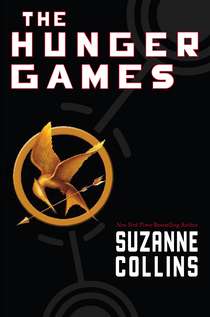
Undeterred, I do plan to see the movie as soon as possible, as I imagine many of you will too. Whether lining up tonight for the special midnight showing or heading out tomorrow, you still have time to read the book before the movie comes out! It may be only eight hours for you to finish if you’re going tonight, but this book is well worth a read in advance of the big screen interpretation. If you need a little push of motivation, please see my March 7th post, “Review of The Hunger Games, by Suzanne Collins.” There are numerous other glowing reviews out there that will likely inspire you to finish reading before the movie begins, and I encourage you to read them as well—just don’t take too long, because you need time to finish that book!

Sadly, I will not be making it out tonight to see the movie, what with the emerging cold and the 5:30 a.m. alarm that will blare painfully in my ear, but my tickets as well as those of my nine enthusiastic friends are already in our hands as we count down the hours!minutes!seconds! until our showing at 9:15 tomorrow night.

In the meantime, here are a few links to more Hunger Games fanfare:

There are plenty of other online blogs and articles for you to check out as you’re standing in line for the movie, so enjoy them while you await what will likely be one of the best movies of 2012. Stay tuned for my thoughts on the movie over the weekend, as I compare it to Suzanne Collins’s outstanding novel.

As for finding a good seat in the theatre…may the odds be ever in your favor!


This One’s for the Kiddos!

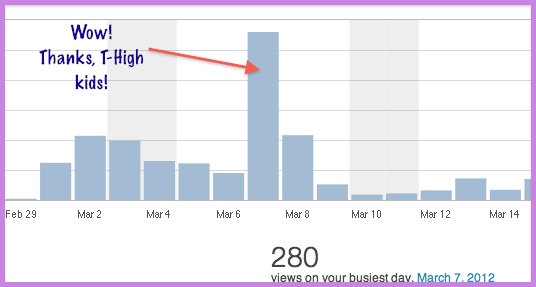
Recently, it came to my attention that several of my students caught wind of my website. I thought this was just a random mention by a few kids, and then I checked my website stats for the day the word spread. As you can see, the results were a little more staggering:

After I saw this, I felt like my life had been written into a Gossip Girl episode for a day, and I decided it was high time to dedicate a post to my awesome kiddos. 🙂

Now, I’m not entirely sure how this happened, but I suppose it could have come about for one of two reasons: genuine enthusiasm for what’s happening on this blog—which is what I’m inclined to believe because, quite frankly, I have some seriously amazing students—or perhaps just a general desire to catch me saying something naughty.

I have heard a few rumors about this idea that would make such a desire understandable. I’m pretty sure the concept of my alleged dirty writing originated last year, when I mentioned in class that I wrote an adult fantasy novel, as in, not young adult fantasy, and somehow this translated into the idea that I write erotica. (Whoopsy! Epic teacher fail moment…)

Sadly, this is not true, but I’m also not going to lie: I write adult fiction, which is to say that within the course of the story, there may be some graphic material (violence, language, sex, overtones, etc.) that may be deemed inappropriate for young adults, just as a TV-MA show might be. In my humble opinion, this sort of reading decision is something teens make everyday, and hopefully this level of reading has occurred with appropriate discretion, parental or otherwise. As a young girl I read far past my age level, but I also knew what was fictional versus appropriate behavior in real life, as I’m going to assume any teen readers have the capacity to do, as well.

So what do I write? I write fantasy, contemporary, and just about anything else that springs into my thick and somewhat pinhead-shaped dome. And since you like to read, I thought it would be fun to know what type of book YOU prefer to curl up with on a lazy afternoon. Adult or young adult, click on your preference below!

Whether you are indeed a student or another reader, young or young-at-heart, thanks for sharing your reading interests back with me and other blog followers. Expect to see more polls and surveys on your interests in the future from time to time, and thank you for participating in this poll!


What Are You Writing Right Now?

Recently I’ve received a few emails inquiring on the status of my novel-in-progress, Kyresa, as well as any other writing I might be doing. I figured I’d provide a quick update for those of you who are following.

After numerous revisions and edits, Kyresa is now in the hands of my five treasured beta readers, who I will fondly refer to as A, B, E, W, and Z. (As a writer, I’m inclined to note that my readers run from A to Z! And thanks A, B, E, W, Z for all your help!) While they are hard at work giving the novel one last go-round, I am in the process of researching and selecting potential agents to represent my work. I’m also working on my “elevator pitch”—that clever, necessary, and useful blurb describing your book in just a few sentences, should you ever be trapped on an elevator or similar thirty-second scenario with an editor or agent of your dreams. It seems like such a simple endeavor, and yet, condensing an entire book and the fantasy realm it encompasses into just a few sentences is actually quite challenging. I’ve come up with a few tentative possibilities so far, so I’m almost there…or will be, once I merge all three emails in my inbox and five post-its on my dashboard together into one nice, clean statement!

Meanwhile, I am also researching literary journals and anthologies for two short stories: “Circubus,” a supernatural fantasy piece, and “Mounds,” a contemporary/mainstream work. I’ve found a few great places for “Circubus” and just sent it to my first choice magazine—cross your fingers! I will be focusing on homes for “Mounds” over the next week.

Once those are out, I will be continuing my work on the second draft of another novel, as well as toying with two prospective short story concepts. All three items are definitely in their very early stages, but I’m excited about them. These will temporarily be put on hold when Kyresa comes back from the fantastic A, B, E, W, Z squad, so that I can wrap up the novel and start to send it out into the world…

Like many things we do in life, it’s all a process. Fortunately, it’s a very enjoyable one! 🙂


The Imaginations of Children

This past weekend I saw my niece—also known as the Most Adorable Niecey on the Planet—and she spent a good amount of time being her charming, four-year-old self. Since my sister recently moved a few hours away, I often find myself missing the little munchkin for quite a while after I see her.

Today I happened to remember some of the exuberance my Niecey shared as she showed me her dolls, shoes, hair, and jewelry. She, like most children, has a vivid imagination, as well as a high-pitched zeal with which she loves to share her young, open-minded ideas. On any given day I can probably recount ten favorite memories, but today I thought I’d share just one.

About two months ago, the Most Adorable Niecey stayed overnight, and in the morning she tapped me gently on the shoulder. “Auntie Eva,” she whispered, “it’s time to wake up.” Groggy and somewhat delirious, I managed to wake—albeit slowly—as she explained that it was time to play Princess.

“Princess!” I said, rubbing my eyes. “How do we play that?”

“Well, I’m the Pink Princess,” she said, waving her hands in the air. “I have a pink dress, a pink crown, and a pink wand. I also have pink jewelry!” she squealed proudly, pointing at her bare (but remember, not really bare) fingers and wrist. “It’s time for you to get up, so you can be the Purple Princess.”

“Oh my!” I said. I propped myself up on the pillows. “How do I do that?”

“First, we have to put on your purple dress. Sit up.” I did, and she proceeded to simulate sliding the dress over my head. “Now for your purple crown and wand.” She placed the crown on my head and the wand in my hand, smiling proudly as she adjusted the way I held it. “You have to hold it this way for spells,” she whispered.

“Oh thank you,” I said. “What’s next?”

“Well of course you need purple jewelry. Hold out your other hand.” She slid the imaginary rings onto my finger and clasped a bracelet around my wrist. “I’ll give you your shoes when you get out of bed. Now come down here,” she said, wriggling to the floor and pointing at a two-by-two area on the carpet. “This is my pink castle. And over there is your purple castle. Hurry! You have to get there fast, the dragon is coming!”

“Ick!” I shrieked, jumping out of bed. I climbed over to the area she designated as my purple castle, and then she tossed over my purple shoes. (Yes, she actually simulated tossing over a pair of shoes.) “Do I have to stay here?” I asked.

“You can come over here,” she said, lifting a warning finger. “But you have to move very quickly, and you’re only safe if you wear the purple shoes. Put them on, fast, and come to the pink castle!”

Naturally, I did, and then scooted over to her castle. Clearly, it was the place to be!

We played for a while like this as she told me about all the creatures in the land (the dragon, some magical cats, an enchanted forest, even more glittering purple and pink jewelry!), and eventually my need for coffee won out. “Sweetheart,” I said, “I’m just so tired, I fear the dragon will catch me because I’m moving too slowly. I really need coffee.”

“Silly Auntie Eva, I can make you coffee here in the pink castle!” she laughed, whirling her hands around until she produced a cup of coffee. Not quite real enough for my taste, but I let it slide for another ten minutes until I convinced her Auntie Eva’s kitchen was a safe place away from evil dragons, and that eating pancakes would give her strength to fight them off.

It’s a silly story, true, but the way she weaved her imaginary world captivated me. Each time I see her, she has created some romantic tale of fantasy and magic, a world she wants to involve everyone in. It’s a gift that most children have in their early years, making our already interesting world so much more amazing, colorful, and even a little more magical.

For some scientific reason we tend to lose this ability as we get older, both in our loss of fantastical thinking and in our hesitation to express these ideas. It’s a shame, really—but also the reason so many of us turn eagerly to the wild creativity we see in books and movies, hoping, if only for 300 pages or two hours, we might recapture our ability to run free through someone else’s imaginative musings. These pieces capture us in a world we might otherwise not experience, letting us imagine that we, too, are still the Pink and Purple Princesses (and Princes) of our youth. Those memories may be buried deep within, but somewhere in your mind and heart you might remember these moments bringing a smile to your face…so don’t forget to let them out every once in a while to play.

*** A giant kiss to my adorable niecey V! ***


How Does One Write?

Ink and paper are sometimes passionate lovers; often times brother and sister; and occasionally mortal enemies. —Terri Guillemets

Upon learning that I love to write, several of my students have stared at me with big, incredulous eyes and slight expressions of horror. Sometimes, they even mutter the most startled of questions:

“How do you do that?”

“You wrote a novel, Miss Rieder? How could you write that long? I hate writing!”

“Whhhhyyyyy?”

I suppose there may have been a time that I didn’t love writing as much as I do now, long, long ago and beyond the farthest reaches of my memory. The truth is, all of us who love writing still have moments where we despise this torturous thing we do, when the act itself feels akin to gauging one’s eyes out with a dirtied, garbage disposal-marred fork.

But then it comes to you—that rush of an idea, that slick purge of words, phrases, and sentences all joined together by a neat sequence of punctuation and tempo. Your blood warms, your pulse races, and you delve right back into that which you love and enjoy. You forget the agony that was your momentary frustration. It’s as if, once again, you’ve found your passion, and by letting the words pour onto the screen before you, you have let your soul free to discover something trapped deep within, ready to emerge onto the world.

So what do you do to get there? How do you practice the art of writing enough to be able to feel that spark more easily and more often? How, exactly, does one write?

I am by no means an expert, nor would I claim to be. However, I have found that by diligently sticking to it over the years, the time it took to produce something became less of a strain and instead, a treasured activity. Here are some of the strategies that led me to enjoy writing more regularly:

  • Write everyday. This is the best tip any writer will ever give you. I’ve read it a thousand times over, and each time, I vigorously nod my head in agreement. Whether you write in a journal, set a daily word quota for your book, jot a poem on a café napkin, or simply carve out x minutes to ignore the world and write a few sentences, you’ll get there. My favorite strategy? Once the kids leave for lunch, I try to write for ten minutes before I eat. What I’ve written churns around in the back of my mind for the rest of the day, and then at night I can flesh the ideas out further.
  • Carry post-its everywhere. This is both a helpful assist and a colorful way to decorate everything in your life—my white kitchen cupboards have a minimum of six pink or yellow post-its of ideas, phrases, names, or characters at any given moment, all jotted down on post-its while I was at the gym, in the car, at work, or out with friends. Keep them in your bag, your binder, or even your wallet.
  • Turn off the phone when you write. I break this rule for myself all the time, and when the phone rings I kick myself for forgetting. If you’re writing, write. Ignore the the rest of world, you have something to do.
  • Watch the people around you. That alone can inspire characters and story lines that you long to tell about.
  • Read the first page of your favorite book. Remember the spark of excitement you felt when you read it the first time? Use that sensation as inspiration to create something just as intriguing for your own audience.
  • Force yourself to sit in front of the keyboard for a specific length of time. No internet, no games; just you and an open document. A white screen is blinding. Black words on it are far less jarring. Start writing!
  • Keep a card catalog of ideas. These may be transfers from your post-its, or just something you do in your spare time. I have a file divided into three parts: one for names, one for ideas, and one for settings. Even if I’m not using something from the file, sometimes just thumbing through it gets me motivated.
  • Don’t forget to take a break. This may seem like a total contradiction to my first recommendation, but once you’ve been writing faithfully everyday and you’ve built a momentum, you occasionally hit a wall. It happens. Take the evening off and relax with a good book, letting your brain dwell on someone else’s hard work instead of yours. Tomorrow, pick it up again.

There are thousands of strategies out there—you just have to find the set that works for you. If you really want to write, eventually you’ll find your rhythm and will be able to stick to it. Practice and patience—and lots of time—will eventually turn writing into something that you love.

Happy writing, everyone!


Review of THE HUNGER GAMES, by Suzanne Collins

First take: WOW.

Second take: Thank god I borrowed the next book from my friend so I can start it tonight!

I read about The Hunger Games in Entertainment Weekly about nine months ago and found the concept incredibly intriguing. Kids fighting to the death on demand of a Capitol entity, as a punishment for the people’s rebellion? What an insanely unique idea for a novel!

Over the summer I vacationed to Aruba; on the plane, a young man of about twenty sat beside me reading the third book in the series, Mockingjay. He barely acknowledged his soda and peanuts as he pored over the book, eventually lowering it to his tray table with a big sigh.

“What did you think?” his girlfriend asked.

“It was incredible,” he breathed.

He then proceeded to go on and on about the book to the point where I finally said, “Um, hey, some of us still haven’t read it. Can you maybe not give away the whole story just yet?” We had a good laugh, and he informed me that he’d been reading the series nonstop over the last few days and simply couldn’t put it down. 

I proudly purchased my copy just after I returned home. Sadly, I got distracted working on Kyresa (okay, that’s not such a sad thing), the school year started, and various other bouts of drama abounded—but I swore I would read that darn book before the movie came out if it killed me. Well, I finished it, and you know what? The kid was right.

From the first page, I refused to put this book down. Narrated by sixteen-year-old Katniss Everdeen, a girl in the poorest District who volunteers in place of her twelve-year-old sister, Hunger Games contains a carefully blended scene of both science fiction and fantasy. Gone is the world we know, replaced instead by a cruel Capitol bent on punishing the people for their past defiance. Katniss is a skilled huntress who has spent her life unintentionally preparing for the Games, by providing for her family since her father’s death. Headstrong, clever, and hosting a keen understanding of the natural world around her, Katniss is a phenomenal teenage heroine. She bravely enters the Gamemakers’ world, hoping to survive the brutality that has reminded the world of their place under the Capitol in a manner vaguely reminiscent of George Orwell’s 1984. Once in the arena, Katniss fights against a collection of terrifying opponents, both human forces and natural elements alike. Meanwhile, she also struggles against an acquaintance from home, the questionable Peeta, with whom she learns a bit about herself as well as her transforming emotions throughout the course of the Games.

Though the book is geared toward a younger audience, any adult can enjoy this book (I personally know of four who can’t stop raving about it). The reading is smooth and intriguing, with rich and engaging characters whose complicated flaws and endearing traits wrap you up in concern as you follow their journey. Even the dangerous, bully teens who seek to snuff the lives of those around them are characters you can’t help but feel sorrow for, as their morals are caught in the Capitol’s inhumane rules and expectations. I had a few flashes back to Connell’s “The Most Dangerous Game” as well as Golding’s Lord of the Flies as I read, though, I have to admit, I took far more pleasure in this read—and I’m a pretty big fan of the aforementioned pieces.

At the gym today, a gentleman asked me how I could move so fast on the elliptical machine while still reading [and clutching] a book. My response?

“Because this book is amazing! You should read it too!”

I’m so excited to read the next book of the series that I’m afraid it’s now time to sign off and read!

(Be sure to check out Suzanne Collins’s website: http://www.suzannecollinsbooks.com/index.htm for more information on the trilogy.)


But What Does Charity Have to Do with Fantasy?

This is the very question I asked myself as I ran at a blazing pace (humor me) on the treadmill yesterday, feeling the urge to write about charity, but also puzzling over how to unify the two concepts.

So I ran, and I ran…and it suddenly hit me as hard as the cramp gnawing at my side: charities are about giving, about caring, and about helping others to reach their goals and dreams. We who have the ability to give, the capacity to share our compassion—if we really make an effort, then we can help those who need our assistance for anything from healing, to resources, to companionship. No matter what the objective, charities provide a clear path toward fulfilling a longing, or a dream—the attainable fantasy of making this world a better place for everyone, not just those who can help themselves.

Saturday night I attended a wonderful charity event for the Ria Foundation, which was founded after the unfortunate passing of a talented young artist named Maria Ann Hsiao, or “Ria.” For the last ten years, the Foundation has been running a program called Art4Kids (http://riafoundation.org/kids.html), bringing art and self-expression to children throughout California and Hawaii and inspiring them to explore their own creativity. As I listened to the presentation about Art4Kids, I thought about how many children could benefit from organizations like this, and also how many children, and people in general, just need a little love and support from others.

My parents are heavily into charity organizations and charity work, and it has rubbed off on me over the years. The reward of helping someone else live the fantasy that we so often take for granted—homes, health, companionship, and food in our bellies—is a pleasure in its own right, and unfortunately, it’s not a topic we often get to discuss with one another.

So, I thought I’d share a few of the organizations that I’ve investigated in the last few years; though there are an infinite number to choose from, these are some of my favorites. I’ve provided an extremely brief description of each, so please be sure to click on the links for more detailed information.

  • Water.org — this organization builds wells and sanitation systems, bringing safe drinking water to communities in Asia, Africa, and Central America.
  • Madre.org — promotes women’s rights and safety in war-torn countries, and supports women’s voices where they remain otherwise unheard.
  • Bestfriends.org — Best Friends Animal Shelter is a no-kill sanctuary in Utah, caring for wild and domestic animals until they are rehabilitated or adopted.
  • Heart.org — The American Heart Association provides tons of research and care for heart diseases. This one is particularly dear to me—several years ago, a close family member was diagnosed with a rare heart condition. She is quite well now, and the organization’s research remains imperative.
  • Dtrf.org — promotes research for a rare and often fatal disease that forms locally aggressive tumors in connective tissues and destroys neighboring tissues—even bones and organs. A close friend of mine has this condition, but she’s had a clean bill of health for about two years thanks to some incredible doctors and the research funded by this group.
  • Africare.org — works to improve the quality of life for people in Africa through sanitation and water services, care and education for HIV/AIDS, and food security for its people.
  • Bbbs.org — Big Brothers/Big Sisters is an experience-based program connecting a “big” brother or sister with a “little” considered in need of company beyond his or her circumstance. I had the pleasure of working with a charming girl for about two years through this program, and we had a fantastic time together every time we met. The time commitment is minimal, but the rewards for both parties are tremendous.

This list is by no means a suggestion, nor is it a very exhaustive one. If you are interested in a charity, do some research to find an organization that fits your heart. The American Institute of Philanthropy gives a great list of top charities based on those that use the majority of their funding for causes and research instead of administrative costs at http://www.charitywatch.org/toprated.html.

If you’ve never had the opportunity to donate or work with a charity, I encourage you to consider it—it is an incredibly satisfying experience, and if every one of us could give even a little, we could share the fantasies and dreams we’ve built for ourselves with so many others around the world.


The Journey

I have been writing for as long as I can remember. If I trace back far enough, I think it all started with a children’s Halloween writing contest in the local paper when I was about six years old. I remember a limit of 500 words. I also remember thinking, “How can I possibly tell this story in only 500 words?”

In sixth grade I wrote “The Bear with a Tutu,” a short story about a ballerina turned into a bear by an evil witch. I don’t remember much about this piece except that it lives in a fire-safe box in my office, and more importantly, that my teacher wrote some incredible words on the top of the first page: “Eva, this is so creative. Please never ever stop writing!” She was an inspiration to me, and so I took her words to heart.

For every breakup, I wrote a poem or twenty; for every stress, I grabbed my journal; and for just about everything else, I delved into the mind of that little girl who wrote about a tutu-wearing bear. I also began to feast on the works of some of the most creative authors in an eclectic array of genres, leading my writing to transform from fictional biographies (strangely about more ballerinas), to horror, and soon after fantasy—and it was in this genre that I found I wanted to thrive. I had a wonderful mentor at the Institute of Children’s Literature who pushed me to create the first three chapters of a young adult book, and in college I had a professor who encouraged me to delve into more mainstream, deeper work, leading me to fall equally in love with the contemporary/mainstream style, and also the idea of writing for adults.

Several years later, I’m still writing—although my journey has been a bit of a wild zig-zag across multiple paths and far too many years of distractions. I have a day job and about fifty hobbies, but I also have a passion to write, and for the rest of my days I intend to live my life immersed in this passion.

And so, I welcome you to join the folds of what Eva Rieder always intended for herself to be, and I thank you for your thoughts and ideas as I navigate that which is truly the center of my being. Perhaps, along the way, life will lead you to a similar place—with a promise to follow your true passion.